
Key takeaways
Short answer: A local citation is any place online that lists your business name, address and phone number, like Yelp, Apple Maps or your chamber of commerce. Citations still matter because customers use them to reach you, and experts believe Google and AI tools use them to confirm your details. They won't carry your rankings alone. Your Google Business Profile and reviews count for more. But wrong or missing listings cost you trust and calls, and getting them right is simple, steady work.
- A citation is any listing or mention of your business name, address and phone number on another website.
- Accuracy beats volume. A short list of correct listings on sites people use is the goal.
- Experts rate citations as a small part of Google Maps rankings, but about twice as important for AI search.
- Start with Google, Bing, Apple Maps, Yelp and Facebook, then add the sites your customers use.
- Old phone numbers, old addresses and duplicate listings are the first things to clean up.
What is a local citation?
A local citation is any mention of your business on a website you don't own, showing your name, address and phone number. Marketers shorten that to NAP. Your Yelp page is a citation. So is your Better Business Bureau listing, your chamber of commerce entry and the line in the town paper about the Little League team you sponsor.
A good listing goes further than NAP. It can also carry your website, hours, services, photos and reviews. Fill in whatever a site gives you room for.
One thing that trips people up: "citation" has a second meaning now. When ChatGPT shows the sources behind an answer, those get called citations too. In this article, a citation means a listing or mention of your business.
Why do local citations still matter for local SEO?
Citations still matter because they back up your story. Think about a plumber's van, invoice and license. If all three show the same company name and number, nobody thinks twice. If each one shows something different, a homeowner starts to wonder who's actually coming to the house.
Experts believe search engines and AI tools run a similar check across the web. Here are the four ways that pays off.
Do citations put you where customers already look?
Yes, citations put your name on sites that already rank. Search "plumber" plus your town and you'll often see directories and review sites on the first page, right beside local companies. You don't have to outrank those sites. You just have to be listed on them, with the right details, when someone with a leaking water heater clicks through.
This matters most for the customer who doesn't know your name yet. They're searching for a service, not a company. A complete listing gives them one more road to your phone.
Do citations help with AI search?
Yes, and experts now rate them higher for AI search than for Google Maps. AI tools build their answers from what the web says about you. When someone asks ChatGPT for a good plumber nearby, it can only recommend a business it can find. In Whitespark's 2026 survey of 47 local search experts, citations got about twice the estimated weight for AI search that they got for Google Maps [1].
Nobody outside these companies knows the exact sources. So don't bet on one directory. Be correct everywhere that counts.
Do citations make you look established?
Yes, because showing up in many trusted places looks like a business people know. Google says local results are mainly based on relevance, distance and prominence, and that prominence means how well known your business is [2]. Google says that's based partly on how many websites link to you and how many reviews you have.
Google doesn't publish a rule about directory listings. But real reviews on more than one trusted site help with customers too, because plenty of homeowners check more than one place before they call.
Do citations give you backlinks?
Sometimes, and that's a small bonus. A backlink is simply another website linking to yours. Many directories tag their links so they may pass little or no value, and Google treats those tags as hints [3]. Take the links you get, but don't build listings for the links alone.
How much do citations really move your rankings?
Citations are a supporting player, not the star. Here's how those 47 experts split the weight in Whitespark's 2026 report [1]. These are expert estimates, not numbers from Google.
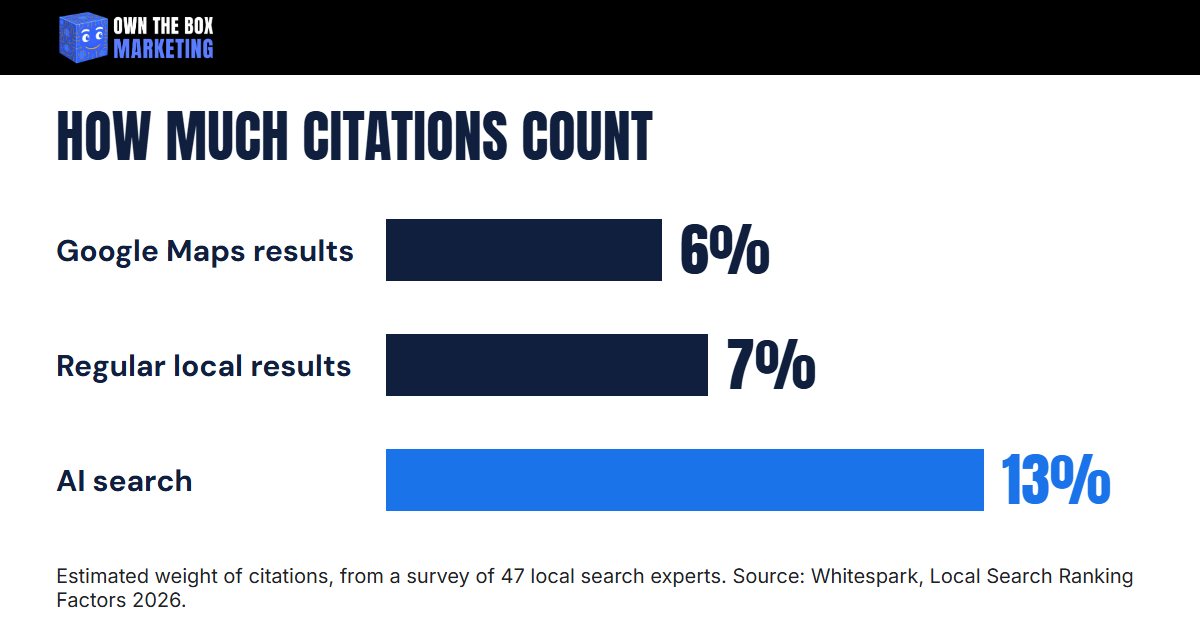
For Google Maps, they gave your Google Business Profile 32% and reviews 20%. Citations got 6%. Whitespark also says citations have been losing ground for years as a local ranking strategy, and that AI search is breathing new life into them [1].
So here's the honest order. If your Google Business Profile is half finished, fix that first. If you're short on reviews, work on that next. Then clean up your citations, because a wrong number on a popular site loses calls no matter where you rank.
Put these ideas into action for your business.
See how local SEO worksWhat kinds of citations are there?
There are two kinds. A structured citation is a listing in a directory, with neat fields for your name, address and phone. An unstructured citation is a mention in regular writing, like a news story or a trade association page. Most small businesses should work through them in this order.
| Type | Examples | Why it counts | What to do |
|---|---|---|---|
| Maps and search | Google Business Profile, Bing Places, Apple Maps | Where people find directions and phone numbers | Claim them first and match them exactly |
| Big directories | Yelp, Facebook, Better Business Bureau, Foursquare | Well known to customers | Claim, complete and add photos |
| Trade sites | Angi, Thumbtack, Houzz | Customers there are already shopping for your service | Pick the ones that fit your trade |
| Local sites | Chamber of commerce, town pages, trade associations, supplier dealer lists | Shows you belong to your community and trade | Join or ask for a listing |
| Mentions in articles | Local news, industry associations, "best of" lists | Rated highly for AI search [1] | Earn them over time through real work |
That last row deserves attention. The experts ranked being on expert-picked "best of" lists number one out of 187 factors for AI search, and the quality of mentions in articles number four [1]. You can't buy your way into a good local news story, but you can sponsor the team, join the chamber and tell the paper when you do something worth printing.
How many citations does a small business need?
There's no magic number. The right amount depends on your trade and your market. A roofer in a big city faces different competition than a septic company in a small town, and the sites that matter for each one are different.
Quality beats quantity. A short list of accurate listings on sites people actually use will do more for you than a long list on directories nobody visits.
Here's a quick way to find your own list. Look up the top three companies in your trade and town, then search each company's name. Note which directories keep coming up. Those are the sites worth your time, and any you're missing go on your to-do list.
How do you build and clean up your citations?
You build citations by locking in one exact version of your details, then working down the list from the biggest sites to the smallest. Here's the order I'd follow.
- Write down one master version. Your exact business name, address, phone number and website. Decide on small things too, like "Street" or "St." and whether "LLC" is in the name. Copy and paste from this every time.
- Fix the big sites first. Start with Google, Bing, Apple Maps, Yelp and Facebook.
- Add the sites for your trade. Use the table above and the list you built from your competitors.
- Hunt down your old information. Search your old phone number and any old address in quotes. If you've moved or changed your name, the old details may still be out there.
- Claim listings before you create new ones. Many directories already have a page for you, pulled from other data. Claim it. If you find two pages for one business, ask the site to merge or remove the extra one.
- Check back. Update every listing when something changes, and do a quick review a couple of times a year.
Here's what that looks like with a made-up company.
| Site | What it shows | Problem |
|---|---|---|
| Master version | Joe's Plumbing and Heating, 100 Example Street | None. Everything should match this. |
| Directory A | Joes Plumbing LLC, 100 Example St. | Name doesn't match |
| Directory B | Joe's Plumbing and Heating, 42 Old Road | Address from two moves ago |
What if you work from home?
If you don't serve customers at your address, Google says to hide it on your Business Profile and set a service area instead [4]. Its own example is a plumber who runs the business from home. Many directories offer the same choice. Where a site requires an address, use your real one, written the same way each time. Google doesn't accept P.O. boxes on a Business Profile [4].
How do you make sure search engines can see your citations?
A citation only helps if search engines can find it, so check that yours show up. Search your business name plus your phone number and see which listings come back. Open a few while logged out to confirm they're public and correct.
If a listing doesn't show up, finish every field and give it time. New pages don't get picked up right away. You can help by linking to your main profiles from your own website, like Facebook and Yelp in your footer. Your website should also be the clearest source of all, with the exact same name, address and phone number on it.
Should you do this yourself or hire it out?
You can do this yourself if you have a few free evenings and you'll keep up with it. Most main listings are free to set up. The hard part isn't the first pass. It's remembering to update everything after you change a number, add a service or move.
If you'd rather stay on the job, this is part of what I do. Every plan starts with the core listings, including Google, Bing, Apple Maps, Yelp and Facebook, and the Launch plan keeps submitting you across a larger network. I do this after your website is finished, so every listing copies your final details and points to your live site.
Either way, keep it in order. Get your Google Business Profile right, keep reviews coming in, then make sure the rest of the web tells the same story. If you want to see how the pieces fit together for your trade, grab a free SEO book.
Want it done for you?
Book my timeSources
- Whitespark, Local Search Ranking Factors 2026 (survey of 47 local search experts, 187 factors). https://whitespark.ca/local-search-ranking-factors/
- Google Business Profile Help, How to improve your local ranking on Google. https://support.google.com/business/answer/7091
- Google Search Central, Evolving nofollow: new ways to identify the nature of links (2019). https://developers.google.com/search/blog/2019/09/evolving-nofollow-new-ways-to-identify
- Google Business Profile Help, Guidelines for representing your business on Google. https://support.google.com/business/answer/3038177
Frequently asked questions
Are local citations still worth doing?
Yes, as long as you keep them in perspective. Experts rate them well behind your Google Business Profile and reviews for Google Maps, but about twice as high for AI search. Accurate listings also stop customers from calling a dead number.
What's the difference between a citation and a backlink?
A citation mentions your business name, address or phone number. A backlink is a clickable link to your website. A listing can be one or both. A citation still helps customers find you even when it has no link.
Do I have to pay for citations?
Usually not for the basics. Google, Bing, Apple Maps, Yelp and Facebook all offer free listings. Some trade sites charge for leads or extra features, so read the terms before you sign up for anything.
Can a wrong listing hurt my business?
Yes. The clearest damage is a customer who calls an old number and then calls your competitor. Mismatched details can also muddy what search engines believe about you, which is why experts list consistency as a ranking factor.
How long do citation fixes take to show up?
It depends on the site. Some changes show up within days and others can take weeks, especially on sites that copy their data from somewhere else. Don't expect a ranking jump overnight. Think of this as cleanup that keeps paying off.
Do I need citations if I already have a Google Business Profile?
Yes. Your Google Business Profile is the most important listing you have, but it's only one. Customers also use Apple Maps, Bing, Yelp and Facebook, and AI tools read from across the web.
About the editorial team

Steve helps get leads organically for local businesses through proper website design, optimizing customers' Google Business Profiles, requesting reviews automatically and making businesses visible to ChatGPT, Claude, Perplexity and all other LLMs.